Thursday, 12 January 2017

Filming Outside

I am planning to film at night and I want it to appear to be late at night.
According to the BBC, the problems with filming at night includes:

  • Someone can injure themselves or someone else due to fatigue
  • Reduced visibility can affect time and risk
  • Night working on location can increase the security risk
  • It may cause a disturbance to the general public
The BBC outlines the General Controls:
  • Give the team as much notice as possible about working at night.
  • Consider the journey times and travel arrangements of the cast and crew.
  • Ensure safety critical activities are scheduled appropriately (e.g. don’t have higher risk work such as stunts at end of night).
  • Consider accommodation, taxis and arrangements for transport; these may need to be offered.
  • Consider a health assessment via a questionnaire if the night working is to be regular.
  • Keep access clear of equipment and cables.
  • Ensure that access and egress routes are adequately lit and that cables are properly managed.
  • Identify any potential risks to personal safety at the location.
  • Make the police and / or other relevant authorities aware of your recording intentions if necessary.
  • Contact the Corporate Security Team and liaise with the police if you require further security advice.
  • Consider the length of time and the location of the sequence if the recording may be contentious to the local people or area and the need for security (see pre-vetted list).
  • Ensure arrangements for vehicle parking will be secure.
  • Think about the need for working lights at location and unit base ensuring they do not dazzle drivers.
  • Inform the cast and crew of any particular hazards.
  • Keep noise levels to a minimum in public areas. If significant noise is likely liaise with the locals/the local environmental health officer to make them aware and help manage it.
A way to overcome the problems and hassle with filming at night time is to film at dusk, either during sunrise or at sunset. At this current date-12th January 2017- sunrise is at approximately 8:00AM and sunset is at 4:06PM. In the editing stage for the production, I will have to edit the brightness and saturation to make it appear at night time. I will complete some test footage before, comparing dusk and night filming.

Reflective Comment
The research has allowed me to gain a better understanding of filming when dark. The term 'golden hour' is a term for the sunrise/sunset, it is apparently the perfect period for filming as the sun does not cause any inconvenience. I will use this research for my test footage to compare the quality and credibility of filming at sunset rather than night.

Friday, 6 January 2017

Upcoming Deadline and My Targets

The deadline for my practical work to be completed is Monday 20th February 2017.
As myself and other members of the Sixth Form have mock exams until the 20th January, it will be hard for us to all get together and film with our busy schedule.
My plan is to have the filming completed by the end of the month and to have started my ancillary tasks, the film poster and homepage of the website. This will allow me three weeks to complete my editing and ancillary tasks; with 5 hours of media lessons, free periods and free time at home, this should be completed in time.

Sunday, 1 January 2017

Camera

A fellow student and I have borrowed the Canon 1300D
http://www.whatdigitalcamera.com/buying-advice/buying_guides/canon-eos-1300d-key-features-67106

Camera Specifications:
From Imaging Resource
Basic Specifications
Full model name:Canon EOS Rebel T6 (EOS 1300D)
Resolution:18.00 Megapixels
Sensor size:APS-C
(22.3mm x 14.9mm)
Kit Lens:3.06x zoom
18-55mm
(29-88mm eq.)
Viewfinder:Optical / LCD
Native ISO:100 - 6400
Extended ISO:100 - 12,800
Shutter:1/4000 - 30 seconds
Max Aperture:3.5 (kit lens)
Dimensions:5.1 x 4.0 x 3.1 in.
(129 x 101 x 78 mm)
Weight:24.6 oz (697 g)
includes batteries, kit lens
Availability:04/2016
Manufacturer:Canon

Some negatives include: slow burst shooting with very limited raw buffer; Resolution, dynamic range and high ISO performance trail current rivals; Mediocre autofocus performance; Limited feature set; Very basic movie capture features.

Monday, 12 December 2016

Foley Sound

For my AS Media course I completed some research on Foley Sound, here is what I completed:
What is 'Foley'?
The technique is named after Jack Foley, who established the basic modern techniques still used today. Like most terms that are named in honour of a person; it is customary to spell Foley with a capital "F".
Foley effects are sound effects added to the film during post production. They include sounds such as footsteps, clothes rustling, crockery clinking, paper folding, doors opening and slamming, punches hitting, glass breaking etc. In other words, many of the sounds that are needed are avoided when they naturally occur and they are then artificially added later on.
Foley is usually performed by Foley artists. Ideally they stand on a Foley stage (an area with a variety of possible surfaces and props) in a specialised sound studio. The Foley artists can clearly see a screen which displays the footage they are to add sound fx to and they watch it to get the timing perfected.

Why use 'Foley'?
When watching a film, the audience needs to hear the little sounds (such as the movement of clothes) this is for the picture to come alive. However, these sounds need to be controlled so the dialogue is clear and not obscured.
Foley can also be used to enhance comedy or action scenes. In most comedy films many of the sounds are enhanced for comic effect, and sometimes the Foley sound is the joke. As for action, most fist fights do not involve the actors really hitting each other, and even if they did a satisfying punch sound would not be included. By punching and variously molesting such objects as cabbages, celery and sides of beef, Foley artists can record unique and much more 'realistic' action sounds.

I researched this information on the website http://www.sound-ideas.com/what-is-foley.html


This is a short video showing Foley artists at work.

Some foley sounds I may use in my production is artificial footsteps

Change of Camera

After my post on the camera that I plan to use, I have decided to change my choice.
This is because I do not have enough storage on my iPhone 6. I have 'Zero KB'. The tripod that I also purchased to fit an iPhone is completely pointless as I will just use one to fit the Canon camera.

Thursday, 8 December 2016

Artificial Lighting Tutorials

Credit to mediacollege.com, which includes tutorials for different aspects. I will refer to this website during the production of the film as it is very helpful.

Light is the "raw material" for creating visual images. Everything related to vision is related to light. Whether the medium is still photography, motion film, video or computer-generated images, light forms the basis of everything you see. The information 

Three Point Lighting

This uses three lights, the key light, fill light and back light.
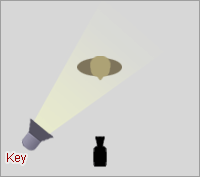
The key light is the main light; it is the strongest and has the biggest impact. The light is placed to one side.

Key Light


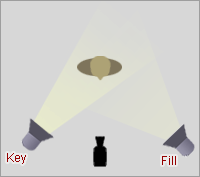
The Fill Light is the secondary light and is placed on the opposite side of the key light. It is used to fill the shadows created by the key light. The fill will usually be softer and less bright than the key. 

Key and Fill


The back light is placed behind the subject and lights it from the rear. Rather than providing direct lighting, its is used to provide definition and subtle highlights around the subject's outlines. This helps separate the focus from the background and provide more of a three-dimensional look.