Tuesday, 20 December 2016

Monday, 12 December 2016
Foley Sound
For my AS Media course I completed some research on Foley Sound, here is what I completed:
What is 'Foley'?
Foley is usually performed by Foley artists. Ideally they stand on a Foley stage (an area with a variety of possible surfaces and props) in a specialised sound studio. The Foley artists can clearly see a screen which displays the footage they are to add sound fx to and they watch it to get the timing perfected.
Why use 'Foley'?
When watching a film, the audience needs to hear the little sounds (such as the movement of clothes) this is for the picture to come alive. However, these sounds need to be controlled so the dialogue is clear and not obscured.
Foley can also be used to enhance comedy or action scenes. In most comedy films many of the sounds are enhanced for comic effect, and sometimes the Foley sound is the joke. As for action, most fist fights do not involve the actors really hitting each other, and even if they did a satisfying punch sound would not be included. By punching and variously molesting such objects as cabbages, celery and sides of beef, Foley artists can record unique and much more 'realistic' action sounds.
I researched this information on the website http://www.sound-ideas.com/what-is-foley.html
This is a short video showing Foley artists at work.
Some foley sounds I may use in my production is artificial footsteps
What is 'Foley'?
The technique is named after Jack Foley, who established the basic modern techniques still used today. Like most terms that are named in honour of a person; it is customary to spell Foley with a capital "F".
Foley effects are sound effects added to the film during post production. They include sounds such as footsteps, clothes rustling, crockery clinking, paper folding, doors opening and slamming, punches hitting, glass breaking etc. In other words, many of the sounds that are needed are avoided when they naturally occur and they are then artificially added later on.Foley is usually performed by Foley artists. Ideally they stand on a Foley stage (an area with a variety of possible surfaces and props) in a specialised sound studio. The Foley artists can clearly see a screen which displays the footage they are to add sound fx to and they watch it to get the timing perfected.
Why use 'Foley'?
When watching a film, the audience needs to hear the little sounds (such as the movement of clothes) this is for the picture to come alive. However, these sounds need to be controlled so the dialogue is clear and not obscured.
Foley can also be used to enhance comedy or action scenes. In most comedy films many of the sounds are enhanced for comic effect, and sometimes the Foley sound is the joke. As for action, most fist fights do not involve the actors really hitting each other, and even if they did a satisfying punch sound would not be included. By punching and variously molesting such objects as cabbages, celery and sides of beef, Foley artists can record unique and much more 'realistic' action sounds.
I researched this information on the website http://www.sound-ideas.com/what-is-foley.html
This is a short video showing Foley artists at work.
Some foley sounds I may use in my production is artificial footsteps
Change of Camera
Thursday, 8 December 2016
Artificial Lighting Tutorials
Credit to mediacollege.com, which includes tutorials for different aspects. I will refer to this website during the production of the film as it is very helpful.
Light is the "raw material" for creating visual images. Everything related to vision is related to light. Whether the medium is still photography, motion film, video or computer-generated images, light forms the basis of everything you see. The information
Three Point Lighting
This uses three lights, the key light, fill light and back light.
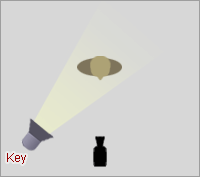
The key light is the main light; it is the strongest and has the biggest impact. The light is placed to one side.
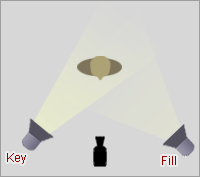
The Fill Light is the secondary light and is placed on the opposite side of the key light. It is used to fill the shadows created by the key light. The fill will usually be softer and less bright than the key.
The back light is placed behind the subject and lights it from the rear. Rather than providing direct lighting, its is used to provide definition and subtle highlights around the subject's outlines. This helps separate the focus from the background and provide more of a three-dimensional look.
Light is the "raw material" for creating visual images. Everything related to vision is related to light. Whether the medium is still photography, motion film, video or computer-generated images, light forms the basis of everything you see. The information
Three Point Lighting
This uses three lights, the key light, fill light and back light.
The key light is the main light; it is the strongest and has the biggest impact. The light is placed to one side.
The Fill Light is the secondary light and is placed on the opposite side of the key light. It is used to fill the shadows created by the key light. The fill will usually be softer and less bright than the key.
The back light is placed behind the subject and lights it from the rear. Rather than providing direct lighting, its is used to provide definition and subtle highlights around the subject's outlines. This helps separate the focus from the background and provide more of a three-dimensional look.
Monday, 5 December 2016
Camera
After using both an iPhone camera and the provided camera, which is now a Canon Legria HFR706, I have decided to use my iPhone 6 to film the final production.
On the left is a sweded film trailer, filmed on an iPhone 6.
On the right is an unfinished AS Media production, filmed on a Canon Legria HFR706.
iPhone 6 has:
On the left is a sweded film trailer, filmed on an iPhone 6.
On the right is an unfinished AS Media production, filmed on a Canon Legria HFR706.
iPhone 6 has:
- 1080p HD video recording (30 fps or 60 fps)
- True Tone flash
- Slo-mo video (120 fps or 240 fps)
- Time-lapse video
- Cinematic video stabilisation
- Continuous autofocus video
- Take still photos while recording video
- Improved face detection
- 3x zoom
- Video geotagging
The Canon Legria HFR706 has:
- 32x Optical Zoom, 57x Advanced Zoom and 1140x Digital Zoom give exceptional shooting range
- 1.4.85” CMOS sensor and rapid DIGIC DC 4 processor give professional quality
- Zoom Framing Assist mode keeps you in control of your shots
- Image Stabilisers keep your footage blur-free
- The fluid Audio Scene Select mode keeps the sound crisp, whatever your shooting
Thursday, 1 December 2016
Storyboard
Reflective Comment
This storyboard allows an understanding and a plan for the production and filming stage of the teaser trailer. This is, however, not fully developed to the best of the ability as further description could be added, as a reflection.
Subscribe to:
Posts (Atom)